
Every few months, someone in a supply chain forum asks a version of the same question: with AI getting this good, do we still need APS?
Fair question. ChatGPT can generate a replenishment recommendation. Copilot can summarize your supply exceptions. New AI-native tools are being funded at a pace that would make a Gartner analyst blush. And the APS vendors themselves are scrambling to rebadge their products with AI terminology, hoping nobody looks too closely at what has actually changed under the hood.
I use both. Daily. I run o9 for supply chain planning at a large FMCG organization, and I use AI tools on top of that to do the analysis that o9 cannot easily produce. That combination — not the theoretical future, but what runs on my laptop right now — is the most honest starting point for this question.
Here is my actual answer, not the vendor’s answer.
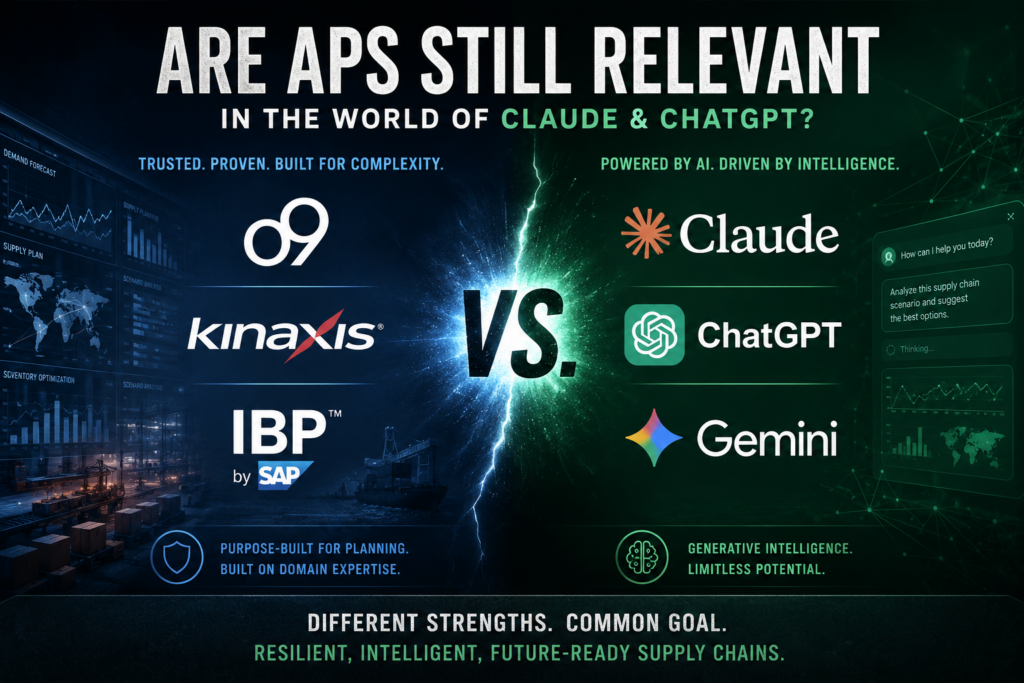
What APS Vendors Say vs. What APS Vendors Have Built
Walk into any o9, Kinaxis, or SAP IBP demo in 2026 and you will hear a lot about AI. Machine learning forecasting. Intelligent alerts. AI-recommended planning actions. The slide decks are impressive.
The reality inside the platforms is messier. The core optimization logic in most APS tools — constraint-based solvers, multi-echelon planning engines, RCCP frameworks — has not changed in any meaningful way. What has changed is the wrapper. More dashboards. More places where the word “AI” appears next to a number. Recommendation panels that surface exceptions slightly smarter than before.
Not nothing. But not the transformation the marketing suggests.
APS vendors have added AI features on top of planning architectures built for a different era. The foundations are largely intact. What you are buying when you buy “AI-powered APS” in 2026 is mostly the same planning engine you would have bought in 2018, with a better interface and a model or two that nudges forecasting accuracy at the edges.
I say this not to be cynical, but because it matters for how you think about the ROI question.
What AI Actually Does Well in Supply Chain Planning
The “AI is transforming supply chains” narrative obscures more than it reveals, so let me be specific.
In my daily workflow, AI does one thing well: it helps me make sense of outputs that APS generates but cannot explain. o9 gives me a production or DRP plan. It gives me numbers. What it does not give me is the narrative — why did available-to-promise drop 12% in week seven? What constraint is actually driving the recommended production sequence? If I need a clean analysis for a commercial review, I’m pulling o9 outputs into an AI tool and building that analysis there.
That workflow is not what vendors are selling. It is an unofficial workaround. But it is where the real productivity gain sits — not inside the APS, but in the gap between what the system produces and what a decision-maker can act on.
AI is also genuinely useful for exception management. Triaging the noise. A mid-sized planning operation generates hundreds of supply exceptions a week. Most do not need human attention. AI can sort that list, surface what matters, and give a first-pass explanation. That frees up planner time for decisions that actually require judgment.
What AI cannot reliably do — at least not yet — is replace the constraint-based optimization APS was built to perform. This is where the debate gets muddled.
The Problem With Skipping the Foundation
There is a version of the AI-replaces-APS argument that sounds reasonable: with enough data and a powerful enough model, you can get from demand signal to optimized plan without building explicit constraint logic. The model learns the constraints from historical behavior.
The problem is that supply chain constraints are not statistical patterns. They are physical, commercial, and regulatory facts. A minimum order quantity is not something a model infers from history — it is a supplier contract term. A co-packing constraint is not a pattern in data — it is a capacity agreement with a third party. A production sequence dependency is not learnable from past schedules — it is an engineering reality about how a line runs.
Build a planning model on top of structured constraint logic and the AI has something real to work with. Ask an AI to derive that logic from messy transactional history and you get recommendations that sound plausible and occasionally are. The risk is not obviously wrong. The risk is that the plan looks right until a planner gets on a call with a factory manager and discovers it is physically impossible to execute.
Any practitioner who has tried to use generative AI directly on a planning problem — without a structured data foundation — has run into this. The model hallucinates with great confidence. In supply chain planning, a confident wrong recommendation does not fail quietly. It propagates into procurement decisions, production schedules, and customer commitments before anyone catches it.
The constraint-handling capability APS has spent decades building — simultaneously optimizing across demand, supply, capacity, lead time, and cost within explicitly modeled rules — is not something you bypass on the way to AI. It is the foundation AI needs to do anything useful at scale.
The Flexibility Problem Nobody Talks About
There is a related frustration I do not hear discussed enough: APS platforms are expensive to customize.
Custom reports in o9 are not something you build on a Tuesday afternoon. They require development cycles, vendor involvement, and a budget that most planning teams do not have easy access to. The platform gives you a plan. Getting that plan into a format useful for a specific business decision is often a separate project — with its own timeline and its own cost.
This is where AI has created genuine, immediate value, not by replacing the APS but by sitting alongside it. The workaround I described earlier is not elegant, but it works: take structured outputs from the planning system, bring them into an AI tool, build the analysis there. Faster than waiting for a custom report. More flexible than anything the vendor will build for you inside a contract cycle.
A stopgap, yes. But also an honest picture of where most planning organizations actually are right now — using APS for what it does well, and using AI to fill the gaps the APS was never designed to fill.
Where This Is Heading
My best guess — and I want to be clear this is a guess, not an analyst forecast — is that the APS category as we know it has about five years before it gets absorbed.
The trajectory is not AI replacing APS. It is AI platforms growing sophisticated enough in their constraint-handling that the line between “AI planning tool” and “APS with AI” stops meaning anything. The question stops being “should I buy an APS or an AI tool?” and becomes “which AI-native planning platform has the best constraint modeling?”
That shift will catch some vendors badly positioned. The ones that bolted AI features onto legacy architecture without rethinking the underlying planning logic will face a hard choice. The ones that have genuinely rearchitected — and a few are doing this seriously — will be in better shape.
For buyers, the practical implication: do not evaluate APS platforms today on their AI features. Those features are mostly marketing. Evaluate the underlying planning logic, the constraint-modeling depth, the data integration maturity. Those determine whether the platform survives the transition — and whether you can build on top of it when real AI integration arrives.
So, Are APS Still Relevant?
Yes. Not for the reasons vendors will give you.
APS are relevant because supply chain planning has a complexity that does not yield to pattern recognition alone. The multi-echelon optimization problem — balancing demand variability, supply constraints, capacity limits, cost trade-offs, and service commitments across a global network — requires explicit modeling. You cannot just throw data at it and hope the model figures out the rules.
AI makes that problem more tractable. It makes outputs more accessible. It reduces the time planners spend on noise. But it does not eliminate the need for a structured foundation underneath.
The companies that get the most from AI in supply chain planning will not be the ones that rip out their APS and replace it with a language model. They will be the ones that first build clean data, rigorous constraint models, and disciplined planning processes — then layer AI on top deliberately, knowing exactly where it adds value and where it creates risk.
The companies that skip the foundation because AI seems faster? That failure mode is coming. We just have not seen enough of it yet to make the news.
The author works in supply chain digital transformation at a large FMCG company and uses both o9 and AI tools daily in a planning context. Views are personal.