
For two decades, companies have used S&OP (Sales & Operations Planning) as their primary cross-functional alignment process. In theory, S&OP is elegant: demand, supply, finance, and leadership come together once a month to review the plan, debate scenarios, and decide the direction of the business.
In reality, however, most S&OP processes look nothing like the textbook version.
Instead, S&OP often feels like a reconciliation ritual, long presentations, mismatched numbers, fragmented logic, repeated questions, and “parking lot” items that never actually get resolved. Many S&OP meetings end with the same line:
“Let’s revisit this after we clean up the numbers.”
This is not a planning problem.
This is a system problem.
Today’s supply chains move too fast for manual S&OP. Markets shift faster than monthly meetings. Constraints appear instantly. Promotions change demand patterns overnight. Material delays can disrupt entire product portfolios. Leaders need real-time insight, not static reporting.
This is exactly why Advanced Planning Systems (APS) have become foundational to modern S&OP.
APS doesn’t just “assist” S&OP.
It fundamentally reinvents it.
Let’s break down exactly how, using real, anonymized examples from our own transformation journey.
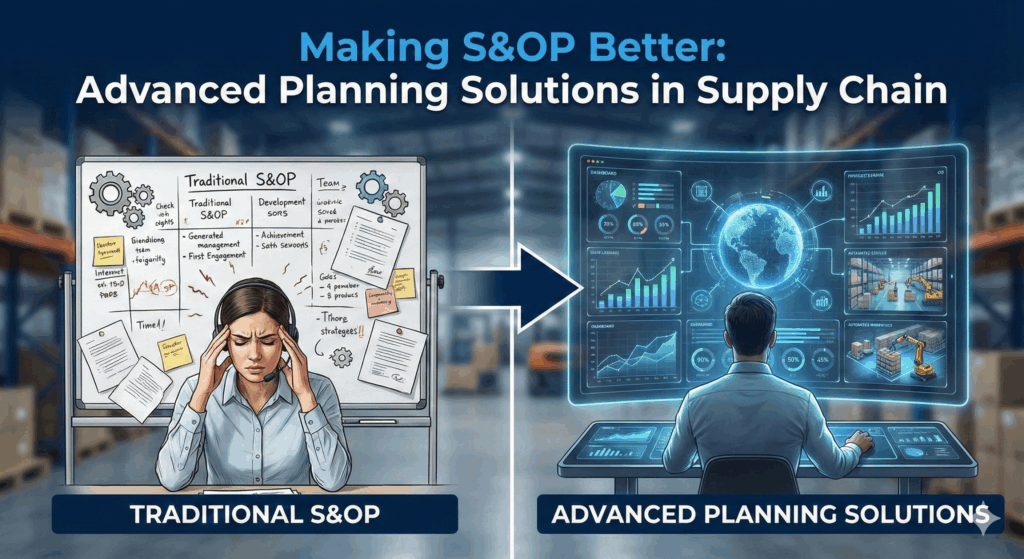
1. The Harsh Truth: Traditional S&OP Breaks Down in Predictable Ways
Across industries — FMCG, retail, pharma, chemicals, electronics — the same S&OP failure patterns repeat. Here are the most common ones we repeatedly encountered during our implementation journey.
A. Everyone walks into the room with different numbers
This is the single biggest reason S&OP loses credibility.
One of the earliest moments in our journey was a mid-month S&OP pre-meeting where five participants brought five different versions of the monthly forecast:
- Sales had their “realistic” number
- Marketing had a “campaign bump” number
- Finance had a “stretch target”
- Supply had a “feasible” number
- The planning tool had the statistical forecast
The meeting derailed before it began.
Not because people disagreed, but because the data wasn’t aligned.
An APS eliminates this on day one by creating one single version of demand truth across all functions.
B. Variability overwhelms manual processes
Supply chains today experience higher volatility than ever. In one instance, during a seasonal period, demand spiked 20% in certain regions because a competitor faced an unexpected outage.
The S&OP cycle was in week 2.
The meeting was scheduled for week 4.
By then, the opportunity would be gone.
Supply couldn’t wait for the next S&OP cycle.
Planners had to scramble manually — often out of alignment with leadership.
APS fixes this by enabling rapid re-planning within hours, not weeks.
C. No one trusts capacity or material visibility
One of our early planning cycles revealed a painful truth:
The organization didn’t actually know its true constrained capacity.
A plant was assumed to have “flexible” output — but APS highlighted that one critical resource was overloaded for 14 consecutive days due to:
- a long changeover sequence,
- a temporary manpower shortage,
- and an overlooked preventive maintenance shutdown.
Traditional S&OP would never have caught this before it became a crisis.
APS surfaced it instantly.
D. S&OP becomes a monthly slide factory
Let’s be honest:
In many companies, planners spend days preparing for S&OP:
- Extracting data
- Cleaning data
- Reconciling data
- Updating Excel models
- Creating PowerPoints
- Double-checking numbers
By the time the S&OP deck is ready, it’s already outdated.
APS replaces all of this with real-time dashboards, automated KPIs, and live alignment.
E. Scenario planning is either non-existent or painfully slow
In one S&OP meeting, a leader asked:
“Can we see what happens if we push an extra 15% volume into Region West?”
The planning team needed:
- 3–4 hours to modify files
- 2 hours to run macros
- Overnight time for supply team to adjust Excel sheets
- Time to create new slides
By the time the scenario came back, the meeting was long over.
APS does this in minutes.
2. How an Advanced Planning System Improves S&OP End-to-End
An APS drives transformation across the entire S&OP cycle — not just one part of it. Here’s how.
A. Demand Review: APS Brings Accuracy, Alignment, and Traceability
In traditional demand review meetings, most time is spent on:
- explaining forecast changes
- reconciling numbers
- justifying deviations
- debating sales vs statistical forecast
- questioning channel assumptions
APS changes this in three major ways:
1. Demand inputs unify automatically
APS integrates:
- sales inputs
- statistical models
- POS/off-take
- seasonality
- promotional events
- channel insights
The forecast becomes multi-layered instead of one-dimensional.
2. Forecast deviations are automatically highlighted
During our implementation, APS exposed a case where a certain portfolio’s Last 30 Days Actuals diverged sharply from the forecast.
This wasn’t visible in Excel because:
- the planner had adjusted the SKU manually,
- the system was missing seasonal switches,
- and the forecast file wasn’t refreshed daily.
APS surfaced the deviation instantly, and S&OP had a more informed conversation:
“Is this a true demand shift or an anomaly?”
3. Consensus forecast becomes easier
The key benefit APS brings is that everyone trusts the same data.
Demand review becomes:
- faster
- cleaner
- less emotional
- more structured
APS brings consensus through transparency, not negotiation.
B. Supply Review: APS Makes Constraints Unavoidable (In a Good Way)
The supply review is where APS creates the biggest value.
Before APS, supply plans often hide structural realities:
- optimistic capacity assumptions
- outdated BOM information
- line-level constraints hidden behind aggregates
- lack of visibility into critical material availability
- manual corrections not traceable
APS eliminates ambiguity.
1. Real constraints appear clearly
In one planning cycle, we discovered that a product family was being “artificially” constrained in the legacy plan due to an outdated routing configuration that forced everything through a bottleneck resource.
APS reran the supply model with corrected routing and immediately unlocked weeks of unnecessary constraint.
S&OP used this insight to shift production strategy.
2. Capacity utilization becomes fully transparent
Line overloads, material bottlenecks, transport limits, warehouse constraints — everything is visible in a single view.
No negotiation.
No guessing.
No heroic Excel gymnastics.
3. Feasible supply plans replace optimistic ones
APS refuses to produce infeasible plans.
If material is short, it shows a gap.
If capacity is insufficient, it flags a violation.
If lead time is unrealistic, it does not assume miracles.
This shift from aspirational to realistic supply planning completely changes S&OP conversations.
C. Financial Review: APS Bridges “Volume vs Value” Like Never Before
S&OP often breaks because finance is working off a different model.
In one of our cycles, finance was planning for a 6% reduction in inventory by quarter-end, while APS showed that inventory would inevitably rise due to:
- a major seasonal build-up
- plant maintenance windows
- supplier lead-time increases
Finance had no visibility into these constraints.
APS solved this by linking:
- volume
- working capital
- cost-to-serve
- material cost
- production cost
- logistics cost
Suddenly, the S&OP conversation became financially meaningful.
Executives could ask:
- “What is the margin impact of Scenario B?”
- “If we shift to plant X, how does that affect cost?”
- “What is the cash implication of the revised plan?”
APS transformed S&OP into a financially intelligent decision forum.
D. Scenario Planning: APS Turns S&OP Into a Forward-Looking Engine
This is where APS truly revolutionizes S&OP.
In traditional S&OP, scenarios are:
- slow
- manual
- simplistic
- often avoided
APS makes scenarios instant.
1. APS scenarios simulate real trade-offs
During peak season, planners evaluated scenarios like:
- “What if we advance production of high-value SKUs?”
- “What if Plant B’s line goes down for 3 days?”
- “What if we shift 20% of demand to a substitute SKU?”
- “What if North region gets hit by a surge?”
APS provided:
- service impact
- capacity impact
- cost impact
- inventory impact
- feasibility
In one example, APS showed that prebuilding a certain SKU increased service by 9% while only raising inventory cost marginally — a trade-off impossible to see in Excel.
2. Leaders decide based on simulations, not speculation
This is the biggest cultural shift.
APS scenarios make leaders comfortable making bold decisions because they can see the consequences.
During one executive S&OP, the group compared three scenarios in real time:
- aggressive build
- conservative build
- region-specific mix reallocation
The decision took five minutes.
Before APS, that debate would have dragged for half the meeting.
E. Pre-S&OP and Executive S&OP Become Faster, Cleaner, and More Strategic
Before APS:
- Planners modify slides until midnight
- Numbers don’t align
- Decisions get pushed
- Follow-ups dominate the next meeting
After APS:
- Dashboards refresh automatically
- KPIs summarize exceptions
- Demand-supply gaps are visible
- Scenarios clarify decisions
- Leadership sees the “why,” not just the “what”
In one organization, Executive S&OP time dropped from 3 hours to 1 hour simply because APS provided a unified view of:
- demand
- supply
- service
- cost
- capacity
- constraints
- risks
- scenarios
APS reduces noise and increases signal.
8 Biggest Improvements that APS Creates in S&OP
Here is the consolidated list of improvements APS brings — with real-world examples from our experience.
1. Single version of truth eliminates reconciliation
A planner once said:
“For the first time, demand, supply, finance, and logistics are looking at the same model.”
2. Demand review becomes structured, not emotional
No more “my number vs your number.”
3. Supply review becomes constraint-driven
APS forces feasibility.
4. S&OP cycle time shrinks dramatically
Planning tasks become automated.
5. Decisions shift from Excel to scenario-based
Executives see simulations, not narratives.
6. Service improves without blind cost increases
APS finds efficient trade-offs.
7. Planners gain confidence and stop firefighting
They transition from “data preparers” to “decision designers.”
8. Cross-functional alignment becomes natural
APS fosters shared visibility.
What an APS Must Have to Improve S&OP (Non-Negotiable Criteria)
Not all APS systems are created equal. Many companies choose tools that look good in demos but fail during real-world implementation.
Here is what a system must have to truly transform S&OP.
1. A powerful scenario engine
Scenarios help the planners answer all the what-if questions of the supply chain. Scenarios must be:
- fast
- flexible
- comprehensive
- constraint-aware
2. A constraint-based solver (hybrid preferred)
Solver is the heart of the APS.
Pure heuristics are too simplistic; pure optimization is too rigid.
Hybrid = best of both.
3. An integrated data model
Demand, supply, capacity, finance — all must be connected.
4. Planner-friendly explainability
Without transparency, adoption fails.
5. Fast data integration pipelines
Data that arrives late is worse than no data.
5 Common Misunderstandings Companies Have About APS and S&OP
“APS will fix S&OP.”
No — APS amplifies your process, good or bad.
“APS automatically gives better forecasts.”
APS improves alignment, not prophecy.
“APS replaces planners.”
APS empowers planners to make better decisions.
“APS eliminates meetings.”
It reduces slide-making, not decision-making.
“The solver will magically optimize everything.”
Garbage in → garbage out still applies. It is important the planners understand how the Solvers work.
Conclusion: APS Doesn’t Make S&OP Better. It Makes It Future-Ready.
S&OP’s promise is alignment.
APS makes that promise achievable by replacing fragmentation with unification, replacing opinion with simulation, and replacing firefighting with foresight.
APS makes S&OP:
- faster
- smarter
- constraint-aware
- financially aligned
- scenario-driven
- integrated
- resilient
And most importantly, APS turns S&OP from a reporting exercise into a real decision-making engine.
Companies that adopt APS correctly don’t just improve S&OP.
They reinvent their entire planning DNA.
Frequently Asked Questions (FAQs)
1. How do advanced planning systems improve S&OP?
They unify data, reveal real constraints, enable rapid scenarios, and help supply, demand, and finance align around a single version of truth.
2. Do advanced planning systems replace S&OP?
No. They strengthen S&OP by making it data-driven and simulation-ready. The process becomes faster and more aligned.
3. Which APS is best for S&OP: o9, Kinaxis, SAP IBP, or Blue Yonder?
It depends on your supply chain complexity, constraints, planning maturity, and integration needs. Hybrid solver platforms (like o9) work best for multi-echelon networks.
4. How do scenarios improve S&OP decision-making?
Scenarios quantify cost, service, and capacity implications before decisions are made — turning leadership debates into simulations rather than opinions.
5. What is the biggest barrier to S&OP success even after implementing APS?
Lack of process discipline, poor data governance, and weak planner adoption. Technology alone cannot fix broken cross-functional behaviors.