
Organizations are building Control Towers to gain visibility, speed, and agility but very few fully understand where an Advanced Planning Solution (APS) actually fits into that roadmap. There is a moment in every supply chain transformation where leadership realizes something profound:
“Our dashboards are not enough anymore.”
The organization may have invested months building “visibility layers” — sleek dashboards, colorful alerts, beautiful maps, dozens of KPIs, and a real-time data lake feeding it all. People celebrate the Control Tower launch. Screenshots appear in town halls. Leadership calls it “a real step forward.”
But soon, reality sets in.
The Control Tower shows problems — but planners still struggle to solve them.
Someone says:
“The Control Tower tells me what’s wrong faster… but it still doesn’t tell me what to do.”
This is the point where every digital supply chain program hits a wall. Visibility alone doesn’t create resilience. Real-time alerts don’t automatically translate into real-time decisions.
A Control Tower, by itself, is a reporting system — not a decision system.
And this is why the companies that succeed don’t stop at visibility. They add the engine that turns visibility into action:
An Advanced Planning Solution (APS).
This article explains, with depth and practical realism, how APS fits into your Control Tower roadmap, why it’s indispensable, and what we learned firsthand from implementing Control Towers where APS ultimately became the backbone — even when no one expected it at the start.
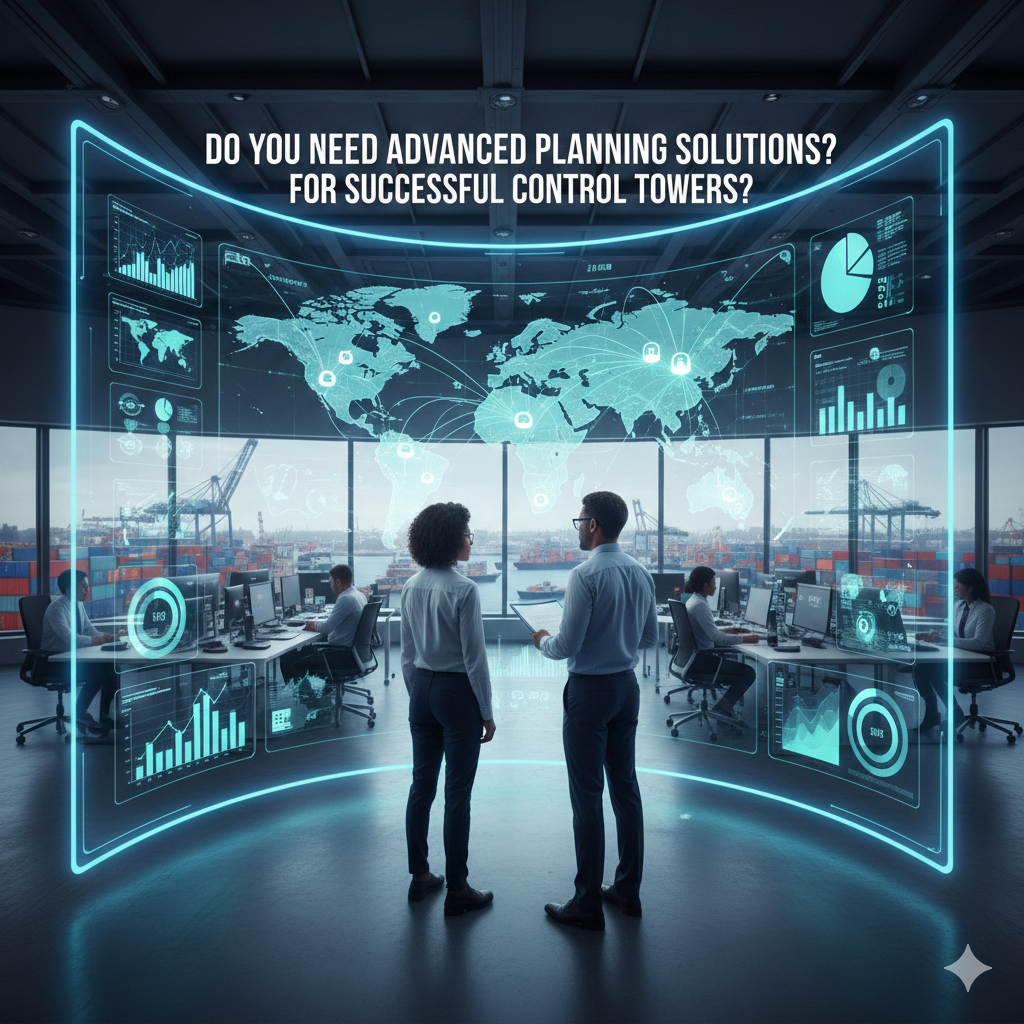
1. The Real Definition of a Control Tower (Not the Marketing Version)
The term “Control Tower” is used so loosely today that two companies saying “we want a Control Tower” might be asking for entirely different things.
The illusion version (what vendors often pitch):
- Beautiful dashboards
- Red/amber/green alerts
- Live feeds
- Inventory maps
- Exception lists
- Email notifications
The real version (what supply chains actually need):
- Real-time problem identification
- Root-cause understanding
- What-if scenario evaluation
- Intelligent recommendation
- Feasible response plan
- Action execution
- Continuous learning
A senior leader once summarized it perfectly in a steering meeting:
“A Control Tower that can’t recommend a decision is just a prettier version of our MIS.”
Visibility isn’t transformation.
Actionability is.
And actionability only comes when a Control Tower is connected to a system that can think, not just display.
That system is APS.
2. Why Visibility Alone Fails: A Story From the Field
A few months into a transformation at a large FMCG company, the team launched an early version of their Control Tower. It had:
- SKU-level service risk
- Plant capacity dashboards
- Shipment delays
- Supplier performance
- Demand deviation alerts
In the first week, the dashboard flagged a severe risk:
“Region East – 9 key SKUs approaching stockout within 5 days.”
Leadership immediately escalated it:
- “Why is this happening?”
- “What’s the plan?”
- “Is recovery possible?”
- “Do we need to expedite supply?”
- “What’s the cost impact?”
- “Can another region share its surplus?”
The dashboard said nothing.
It only repeated the alert — more loudly and more frequently.
The planning team worked the entire night manually creating:
- reallocation scenarios
- alternate sourcing mixes
- prebuild options
- cost estimations
- capacity simulations
- risk profiles
They built four different Excel models.
Each had a different assumption.
No two matched.
The Control Tower gave visibility early — but not the path to resolve the risk.
The next month, the leadership team agreed:
“We need a decision engine underneath the Control Tower.”
That engine became the Advanced Planning Solution.
3. What an Advanced Planning Solution Actually Is? (And Why the Control Tower Depends on It)
Most people think APS = forecasting + production planning + DRP.
That is outdated thinking.
Modern APS platforms (o9, Kinaxis, SAP IBP RS, Blue Yonder Luminate, etc.) are actually:
a. Constraint-Based Reasoning Engines
They understand:
- plant capacity
- lead times
- material availability
- BOM structure
- line calendars
- transport lanes
- MOQs
- shelf life
- substitution logic
Dashboards do not.
b. Scenario Simulation Machines
APS can run:
- “what if this plant goes down?”
- “what if demand spikes 30% next week?”
- “what if supplier lead time doubles?”
- “what if we reallocate 20% to the north?”
Dashboards cannot simulate impact.
c. Optimization Engines
APS can mathematically balance:
- cost
- service
- capacity
- risk
- inventory
Dashboards cannot optimize.
d. Feasible Plan Generators
APS produces:
- actual reorder quantities
- production schedules
- replenishment plans
- sourcing decisions
- inventory strategies
Dashboards cannot generate decisions.
This is why a Control Tower without APS is like an airport control cabin without a radar or flight computer — lots of screens, no real ability to direct traffic.
APS gives the Control Tower its intelligence.
4. Where Advanced Planning Solution Fits in the Control Tower Architecture (The Non-Glamorous Truth)
Many organizations ask:
“Should APS sit before the Control Tower or inside it?”
The truth: APS sits beneath the Control Tower — powering it.
Here’s the correct architecture we ended up implementing after many iterations:

The Control Tower is the interface.
APS is the brain.
Data platforms are the nervous system.
Any other sequence results in:
- dashboards calling for decisions planners cannot make
- alerts without recommended responses
- S&OE firefighting because scenarios cannot be run
- leadership frustration
- Control Tower becoming a reporting toy instead of an operating instrument
5. How Advanced Planning Solution Supercharges the Control Tower (With Real Examples)
Here are the five transformations APS enables inside a Control Tower — each backed by real situations from the field.
1. Converting Alerts Into Action
One afternoon, the Control Tower flagged:
“Plant B overloaded by 18% in the next 10 days.”
In a normal system, this would trigger:
- emails
- meetings
- panic
- Excel runs
- manual simulations
APS made it radically different.
Within minutes, APS produced:
- Scenario A: Shift 25% volume to Plant C
- Scenario B: Prebuild 5 days before overload
- Scenario C: Delay two low-priority SKUs
- Scenario D: Increase manpower on Line 3
And gave:
- cost impact
- service impact
- material requirements
- logistics impact
- feasibility
The Control Tower was no longer a messenger.
It became a decision cockpit.
2. Making S&OE Truly Real-Time
Every supply chain has the “Thursday afternoon crisis.”
For us, it happened when a supplier shipped 2 trucks less than promised, pushing three high-runner SKUs into risk.
Before APS:
- planners scrambled
- WhatsApp groups exploded
- overnight calls began
- Excel chaos ensued
- S&OP became irrelevant
After APS:
- Control Tower flagged risk
- APS ran 3 scenarios
- APS presented 2 feasible recoveries
- Leadership approved instantly
The crisis was resolved in 90 minutes, not 9 hours.
APS turns S&OE into a live operating rhythm.
3. Real Prediction Instead of Reactive Reporting
A Control Tower can tell you:
- “Inventory is dropping.”
- “Transit times are worsening.”
- “Demand is rising.”
APS can tell you:
- “You will hit a shortage in 12 days.”
- “This SKU family will choke Plant D due to shared components.”
- “This lane will be overutilized in 4 weeks.”
During one quarter, APS predicted a constraint on a minor raw material that no planner noticed — because each planner focused on their own silo.
The Control Tower visualized the risk.
APS simulated the mitigation.
Procurement acted early.
Crisis avoided.
This is prediction.
Not reporting.
4. Eliminating Human Bias From Decision-Making
Supply chains carry tribal decision habits:
- “We always source this from Plant X.”
- “Region North is our priority.”
- “Lane C is risky.”
- “SKU A never substitutes SKU B.”
APS comes with no preloaded bias.
In our implementation, APS recommended shifting 12% of volume from a “hero plant” to a less-used one. Planners initially resisted.
But APS showed:
- lower cost
- lower risk
- fewer bottlenecks
- better alignment with material flow
- faster service recovery
It took 15 minutes for leadership to approve the move.
APS introduces mathematical fairness into decisions.
5. Creating a Closed-Loop Planning Cycle
Before APS, the Control Tower cycle was:
- Alert
- Panic
- Excel
- Call
- Meeting
- Temporary fix
- Repeat
After APS, it became:
- Alert
- APS simulation
- Feasibility evaluation
- Decision
- Execution
- Monitoring
Closed loop.
Continuous calibration.
No firefighting.
This is how a Control Tower becomes a nerve center, not a notification center.
6. How Advanced Planning Solution Fits Into Your Control Tower Roadmap (A Deep 7-Step Guide)
Based on real transformation journeys, here is the ideal sequence.
Step 1: Launch Visibility First (But Don’t Stop Here)
Start with dashboards for:
- inventory
- fill rate
- plant capacity
- material shortages
- open orders
- shipment delays
Visibility builds trust.
But it is not the end — it is just the starting point.
Step 2: Strengthen the Data Foundation
A Control Tower is useless if:
- ERP data is inconsistent
- master data is polluted
- integrations break
- calendars are outdated
- BOMs are unreliable
APS reveals all data weaknesses — brutally and early.
Before using APS in your Control Tower, stabilize:
- SKU master
- location master
- network data
- BOM / routing
- resource calendars
- lead times
This is unglamorous but absolutely critical.
Step 3: Implement APS Core Planning Logic
APS needs to reflect your true operations:
- DRP
- PP
- DPP
- replenishment logic
- MRP alignment
- constraints
- substitutions
- network logic
- MILP or heuristic solver settings
Every decision your organization makes manually should be “codified” here.
APS becomes the mathematical replica of your supply chain DNA.
Step 4: Enable Scenarios in Advanced Planning Solution
This is the turning point.
Scenarios bring intelligence to the Control Tower:
- What if demand changes?
- What if material is short?
- What if transport lanes are unavailable?
- What if plant capacity shifts?
- What if a new product launch delays?
APS makes scenario planning instant and repeatable.
The Control Tower surfaces them.
APS computes them.
Leadership selects them.
Step 5: Integrate APS Outputs Into the Control Tower UI
This is where magic happens.
Control Tower should show:
- the issue
- the APS simulation
- the recommended decisions
- the cost and service impact
- the execution pathways
Only then does visibility become action.
Step 6: Build Closed-Loop S&OE Workflows
A supply chain with APS-powered S&OE:
- addresses risks the same day
- re-plans every time constraints change
- escalates only exceptions
- uses APS to validate every decision
The Control Tower becomes the “governance layer.”
APS becomes the “decision layer.”
Step 7: Add Predictive and Prescriptive AI
Once APS and Control Tower are integrated:
- AI forecasting
- AI risk scoring
- AI outlier detection
- ML-based parameter tuning
…become meaningful.
Without APS, AI is guesswork.
With APS, AI becomes force-multiplied.
7. The Most Common Mistakes Companies Make (And What We Learned)
These mistakes come from real transformations.
Mistake 1: Building Control Tower → Then APS
Doing visibility before decision logic leads to:
- alert overload
- planner fatigue
- poor adoption
APS must exist before Control Tower becomes meaningful.
Mistake 2: Treating APS as “just another tool”
APS is the heart of the Control Tower — not an add-on.
Mistake 3: Skipping scenario capability
Without scenarios, a Control Tower is a red-yellow-green wallpaper.
Mistake 4: Underestimating data preparation
APS exposes every master data flaw instantly.
Prepare before integrating into Control Tower.
Mistake 5: Not training planners on constraint-based thinking
Planners must understand how APS reasons.
This is non-negotiable.
8. A Final Anecdote: When Advanced Planning Solution Saved a Multi-Million Dollar Quarter
One of the most memorable examples happened during a major seasonal ramp-up.
The Control Tower flagged:
“Contract manufacturer behind schedule by 2.5 days.”
In the past:
- teams would panic
- expedite raw materials
- call the plant
- re-prioritize blindly
This time, APS simulated:
- bring forward 2 SKUs
- delay 3 low-margin SKUs
- swap 15% volume to Plant X
- pull 10% inventory from North
- reduce lane pressure through RWH
It showed:
- service impact: negligible
- cost impact: minimal
- feasibility: 100%
- execution: immediate
The Control Tower displayed the scenario.
Leadership approved it on the spot.
The quarter closed at best-ever service levels.
9. Final Takeaway: Advanced Planning Solution is the Engine—Control Tower is the Cockpit
A Control Tower with dashboards alone is a rearview mirror.
A Control Tower with APS becomes:
- predictive
- prescriptive
- synchronized
- decision-centric
- planner-friendly
- leadership-aligned
- execution-ready
APS is the brain that understands constraints and simulates solutions.
The Control Tower is the interface that surfaces them intelligently.
When both work together, your supply chain stops reacting and starts orchestrating.
This is what true digital transformation looks like.