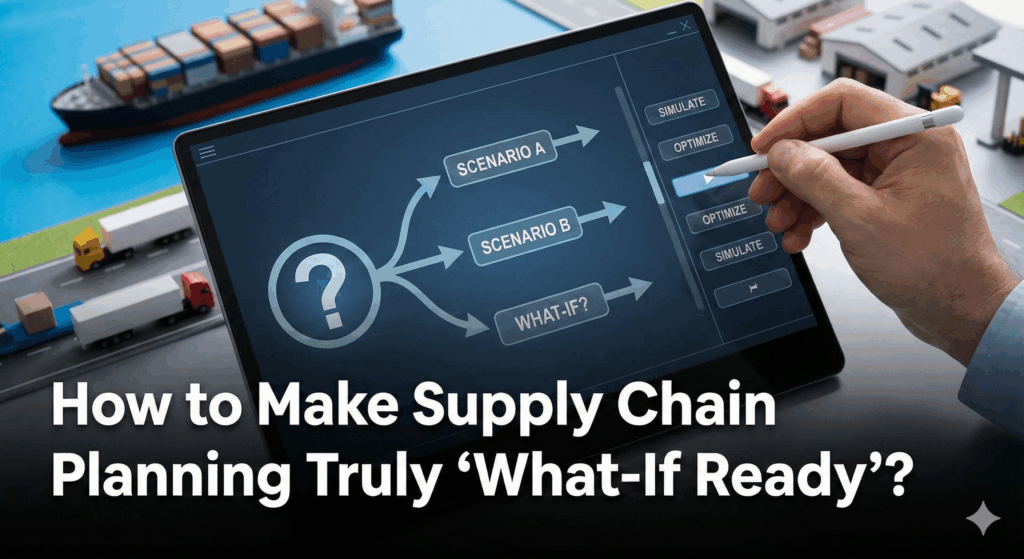
“The question isn’t what-if this happens.
The question is what will we do when it does?”
If the last decade taught supply chain leaders anything, it’s this:
prediction is fragile, preparedness is power.
Forecasts miss. Markets shift overnight. Capacity disappears without warning. Climate swings disrupt sourcing. And Excel — the old safety net — collapses under the weight of volatility.
In this new world, the organizations that win aren’t the ones with the most accurate plans.
They’re the ones with the fastest alternate plans.
This is where scenario thinking becomes the most important planning capability of the decade — and where modern digital planning platforms like o9 are quietly rewriting the rules of supply chain resilience.
This article is a deep dive into how scenario thinking works, why it matters, and how to build a culture that treats “What-if?” as a daily habit, not a crisis reflex in supply chain planning.
1. The Death of the Single Plan
For years, supply chain planning revolved around a single question:
“What’s the plan?”
One plan. One number. One path.
And if reality deviated (which it always did), planners fought fires until stability returned — or the next crisis arrived.
This approach worked when volatility was mild.
But today?
- A port disruption can erase a month of service.
- A sudden promotion can double demand overnight.
- A raw material shortage can collapse an entire category.
- A competitor’s price cut can alter channel flows instantly.
A single plan can’t survive that.
It’s too brittle. Too linear. Too blind to uncertainty.
Modern supply chains don’t need a plan.
They need a portfolio of plans, ready to activate at the speed of risk.
That’s scenario thinking.
2. ‘What-if’ Thinking: Planning for the Unknown
Scenario thinking flips the old planning philosophy on its head.
Instead of building one “best” plan and praying it survives reality, you build multiple impact-ready plans and choose the best path as reality unfolds.
Think of it as creating strategic optionality.
A scenario might answer:
- “What-if demand increases by 20% in the north zone?”
- “What-if Plant B goes down for 10 days?”
- “What-if import lead times extend by two weeks?”
- “What-if we prioritize high-margin SKUs next month?”
- “What-if we push 15% more volume through the east region?”
- “What-if we cut expedited freight by 50%?”
Every scenario tests a different dimension of risk, cost, capacity, or service.
The real value isn’t the output — it’s the response muscle memory the organization builds.
“Scenarios shrink uncertainty by pre-deciding the smartest moves.”
3. Why What-if Thinking Matters More Than Forecast Accuracy
For too long, companies obsessed over forecast accuracy — chasing a number that becomes less relevant every year.
Here’s the truth:
Forecast accuracy doesn’t protect you from volatility.
Scenario readiness does.
Why?
Because scenarios help you:
1. See the full range of what could happen
Not just the expected value — but the tails of the risk curve.
2. Understand the levers you can actually pull
Capacity, inventory deployment, sourcing, prioritization, lane shifts.
3. Quantify trade-offs before they hit
Every plan has a cost. Every reaction has a price.
Scenarios show the ROI of each decision.
4. Respond faster than competitors
Speed becomes strategy.
5. Align cross-functional teams instantly
Debates shift from:
- “Who’s right?” → to
- “Which scenario are we activating?”
That’s real maturity.
4. The Digital Breakthrough: How o9 Makes Scenario Thinking Practical
In the past, scenario modeling was painful:
- Multiple Excel files
- Offline macros
- Manual data stitching
- Zero version control
- No ability to simulate constraints
- Outputs took days (and were rarely trusted)
Today, platforms like o9 have transformed scenario modeling into a native planning behavior.
Here’s how:
a. Copy → Change → Simulate → Compare
In minutes, planners can:
- Duplicate the latest plan
- Change assumptions
- Hit “run”
- Compare outputs side-by-side
This speed is game-changing.
b. Constraints travel with the scenario
Every scenario respects:
- Capacity
- Shelf life
- Lead time
- Network logic
- Inventory norms
- Sourcing priorities
- BOM dependencies
Excel can’t do this.
Digital twins can.
c. Service, cost, and utilization become visible
Every scenario shows:
- Which customers get impacted
- Which plants run hot
- Which lanes spike in cost
- How inventory flows shift
- What trade-offs improve vs. worsen
Scenarios stop being guesses and become simulated futures.
d. Scenarios become conversation assets
Instead of arguing opinions in S&OP, teams compare scenarios:
- “Scenario A gives 3% higher service.”
- “Scenario B cuts logistics cost by ₹1 crore.”
- “Scenario C avoids a stockout but hurts capacity.”
Alignment becomes evidence-driven.
5. The Three Types of Scenarios Every Planner Should Master
1. Stress What-if Scenarios
Designed to test system resilience under pressure.
Examples:
- 20% demand surge
- Major plant shutdown
- Supplier disruption
- Transport capacity cut by 40%
These scenarios reveal the fault lines of the supply chain.
2. Strategic Scenarios
Model long-term shifts and business decisions.
Examples:
- Launching a new region
- Changing sourcing mix
- Reducing safety stock
- Introducing new lanes or capacities
These drive investment decisions.
3. Tactical Scenarios
Short-term levers for next cycle planning.
Examples:
- Advancing production
- Prioritizing high-margin SKUs
- Pulling forward replenishment
- Delaying low-sensitivity customers
These improve the next 4–12 weeks.
Great planning organizations use all three — weekly.
6. Scenario Thinking in Action: A Real Planning Conversation
Imagine an emerging stockout risk for a high-margin SKU.
Here’s how a modern team behaves:
Old World Conversation
- “We need more supply — expedite it.”
- “But costs will spike.”
- “What choice do we have?”
- “Let’s just push it; we’ll fix the cost later.”
Digital Planning Conversation
- Run Scenario A: Advance production → ₹X cost, +3% service
- Run Scenario B: Reallocate from low-priority zones → ₹Y cost, no capacity hit
- Run Scenario C: Delay low-volume SKUs to free capacity → ₹Z cost, small service dip
Then leadership chooses the optimal scenario.
Debate vanishes.
Decisions accelerate.
7. The Six Levers Every Scenario Should Explore
- Demand shocks
Promotions, seasonality, competitor actions. - Supply disruptions
Material shortage, plant downtime. - Capacity shifts
Overtime, debottlenecking, freezing low-value SKUs. - Network changes
Lane options, new RDCs, transport delays. - Inventory deployment
Pull-forward strategies, norm adjustments. - Cost trade-offs
Expediting, mode shifts, production prioritization.
Every scenario is a combination of these six — the full chessboard of supply chain decisions.
8. How What-if Scenario Thinking Elevates Planners
Scenario thinking transforms the planner’s role from reactive analyst to strategic architect.
Here’s the evolution:
| Old Planner | Scenario-Driven Planner |
|---|---|
| Looks backward | Models the future |
| Reacts to issues | Anticipates disruptions |
| Builds one plan | Maintains a plan portfolio |
| Reports variance | Designs choices |
| Debates intuition | Presents simulations |
| Works in silos | Orchestrates alignment |
Planners stop asking, “What happened?”
They start asking, “What if?”
That’s leadership.
9. Building a What-if Scenario Culture: The 10 Habits of What-If Ready Teams
- Run a scenario before every major decision
Make it mandatory. - Maintain a live “Scenario Library”
Common templates for outages, promotions, and shocks. - Base S&OP discussions on scenario deltas
Compare plans, not people. - Assign scenario ownership
Each planner owns a risk category. - Document assumptions clearly
The scenario is only as good as the logic behind it. - Share visuals, not spreadsheets
Stakeholders trust what they can see. - Review “scenario accuracy” monthly
How well did your predictions match reality? - Reward scenario thinking in KPIs
Encourage proactive behavior. - Integrate scenario planning with finance
S&OP should never surprise FP&A. - Treat every run as a rehearsal
Not just for the plan — for responsiveness itself.
When scenario thinking becomes a ritual, volatility becomes an advantage.
10. The Future: AI-Generated What-if Scenarios
The next leap in digital planning is already emerging:
AI that automatically detects risks and recommends scenarios before humans even notice.
Imagine:
- AI detecting a spike in demand volatility and generating 5 scenarios
- AI predicting lane congestion and recommending preemptive rerouting
- AI calculating optimal SKU prioritization under price wars
- AI building cost-to-serve scenarios that maximize gross margin
This is the future of prescriptive planning:
Scenarios you didn’t ask for but needed.
Planners won’t build what-ifs.
They’ll choose from them.
11. Closing Reflection: The Real Purpose of What-if Scenarios
Scenario thinking is not about predicting the future.
It’s about removing the fear of it.
When you have rehearsed the disruption, you stop panicking when it strikes.
When you have simulated choices, you stop debating options.
When you have practiced resilience, you stop reacting and start leading.
“The companies that thrive aren’t the ones that know the future.
They’re the ones ready for any version of it.”
And that is the power of scenario thinking —
the discipline that turns planning from a guessing game into a strategic advantage.