
For decades, operations leaders have lived inside a tug-of-war.
On one side sits service — the promise of product availability, on-time delivery, and customer delight.
On the other side lies cost — the relentless mandate to protect margins, optimize utilization, and reduce working capital.
“Every supply chain meeting ends with the same sentence: ‘We can’t have both.’”
You pull one lever, the other screams.
Increase safety stocks, and your CFO frowns.
Slash logistics budgets, and your sales team revolts.
In this stalemate, “balance” became the holy grail: a vague, moving target no one could truly quantify.
But something is changing.
For the first time, digital planning platforms powered by AI and advanced solvers are quantifying the unquantifiable.
They’re transforming the service-cost trade-off from a guessing game into a decision science.
And in that transformation lies the biggest cultural shift in modern supply chain leadership:
You no longer have to choose between service and cost. You can design for both.
Let’s unpack how.
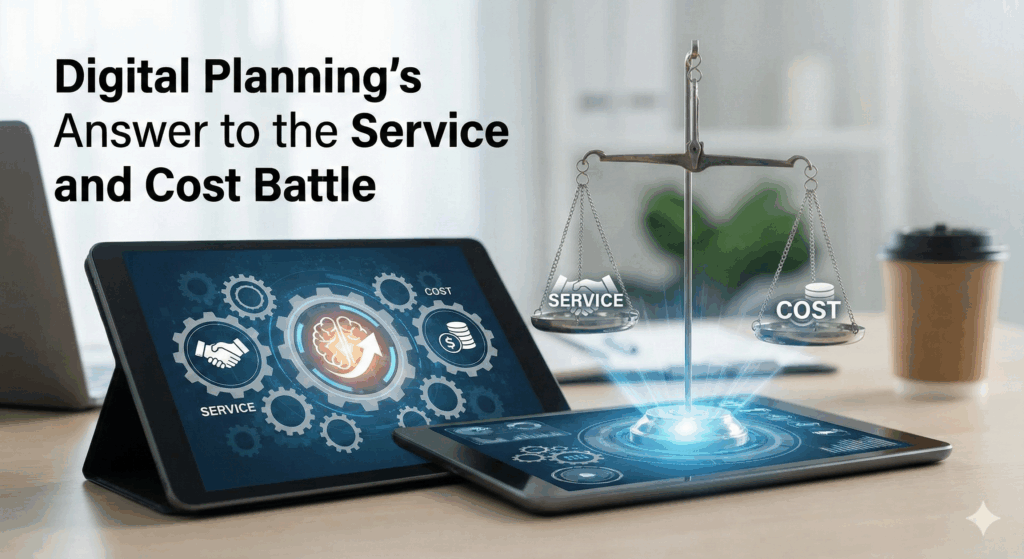
1. The Old Math: How Traditional Planning Got Stuck
To understand the revolution, we need to revisit the math we used to live by.
In traditional supply chains, planners managed service and cost through disconnected proxies:
| Objective | Proxy Metric | Limitation |
|---|---|---|
| Service | Fill rate, OTIF | Reactive; measures past performance, not future readiness |
| Cost | Logistics cost %, inventory days | Lagging indicators; miss trade-offs between nodes |
| Balance | Heuristics, gut feel | Highly subjective, often driven by firefighting |
These metrics lived in silos.
Demand planners aimed for availability. Supply planners optimized utilization. Finance teams focused on inventory turns.
But no one could see the system-wide effect of one decision.
A classic example:
- A planner expedites a shipment to hit service targets.
- Transportation cost spikes by 15%.
- The cost center takes the hit.
- Finance slashes the next month’s budget.
- Service tanks.
- The cycle restarts.
Each team was rational individually.
Collectively, the system was irrational.
That’s because the trade-off was managed after the fact, not designed into the plan.
The old planning world didn’t optimize — it compensated.
2. The Digital Breakthrough: Modeling the Service vs. Cost Trade-Off
Modern digital planning, especially through platforms like o9, flipped this paradigm by introducing one powerful concept:
a living digital twin of the supply chain.
This twin models every constraint, cost driver, and demand signal as interconnected logic.
It’s not a report. It’s a simulation of reality.
When planners run a scenario, the solver-led digital planning system evaluates every path from source to shelf, calculating:
- Transportation cost per lane
- Lead times
- Capacity utilization
- Inventory holding cost
- Service risk due to stockouts or disruptions
Each decision variable, say, shipping direct vs. via RDC, becomes a quantifiable node in the trade-off equation of the solver.
For the first time, leaders can see the true cost of a service promise, and the true service impact of a cost cut.
No more debates based on instinct.
Just data-backed, explainable trade-offs.
Digital planning didn’t eliminate the trade-off. It illuminated it.
3. The New Math: Quantifying the Service vs. Cost “Balance”
So how does the new digital brain quantify balance?
Let’s peek under the hood.
At its core, the modern solver optimizes for a composite objective function that looks something like this:
Minimize (Total Cost – α × Service Benefit)
Where α is a strategic weight — the “importance” assigned to service in your business context.
Behind this equation lies a web of granular logic:
| Cost Drivers | Service Drivers |
|---|---|
| Manufacturing cost per unit | OTIF (On-Time, In-Full) probability |
| Transportation cost per lane | Lead time to customer |
| Inventory carrying cost | Demand volatility coverage |
| Capacity utilization penalties | Customer class priorities |
| Stockout penalties | Product shelf life and substitution flexibility |
The solver simulates thousands of combinations and identifies the point of optimal tension — where marginal cost equals marginal service gain.
That’s the “digital balance point” — something human planners could never truly calculate in spreadsheets.
And it’s not static. It evolves with:
- Fuel prices
- Capacity shifts
- Demand variability
- Sourcing constraints
Your balance point today may be very different three weeks from now — and the system knows it before you do.
4. From Trade-Offs to Trade-Design: A Mindset Shift
The biggest change isn’t technological — it’s philosophical.
In traditional planning, the trade-off was a negotiation between functions.
In digital planning, it becomes a design parameter built into every run.
Here’s what that evolution looks like:
| Era | Philosophy | How Trade-Off Was Managed |
|---|---|---|
| Manual Planning | Service vs. Cost as a tug-of-war | Post-run firefighting; intuitive overrides |
| Automation Era | Service at Cost | Static optimization within narrow boundaries |
| Digital Planning Era | Service through Cost Intelligence | Continuous simulation of trade-offs; decisions by design |
In other words, we’ve stopped treating service and cost as enemies, and started managing them as partners.
Now, when the solver recommends shifting a lane, reducing MOQ, or delaying replenishment, it’s not “cost-cutting.”
It’s designing efficiency into service.
5. How Digital Planning Actually Solves the Trade-Off
Let’s look at five mechanisms inside modern planning platforms that make this possible.
1. Constraint-Based Optimization
Instead of chasing one KPI, the solver evaluates constraints simultaneously:
- Capacity utilization
- Material availability
- Customer priority
- Transportation limits
By balancing constraints mathematically, the system finds feasible plans that don’t sacrifice service for cost, or vice versa.
2. Scenario Simulation: Service vs. Cost
Planners can now simulate what-if scenarios in minutes:
- What if we cut air freight by 10%?
- What if Plant A goes down for maintenance?
- What if we hold 2 extra days of stock in North?
Each scenario yields clear service-cost deltas — empowering leadership to decide with facts, not fear.
3. Dynamic Inventory Norms
Digital twins adjust inventory norms automatically based on volatility, shelf life, and lead times.
This ensures service levels stay consistent without overstocking.
Your “safety” becomes intelligent — not static.
4. Lane Prioritization and Load Optimization
The solver continuously analyzes transport lanes for cost vs. utilization trade-offs — shifting FTL/PTL logic dynamically.
No more blanket rules like “always FTL.” The system knows when partial loads make economic sense because of service value.
5. End-to-End Visibility
When demand, production, and distribution plans share a single model, the organization sees the true cascade effect of every decision.
Reducing one plant’s overtime might look good locally — until the model shows lost sales upstream.
That’s how digital transparency kills siloed optimization.
6. The Results: Quantifying What “Better” Looks Like
Real transformations that embraced this approach have seen dramatic results.
While numbers vary by industry, the patterns are consistent:
| Metric | Typical Impact After Digital Planning Adoption |
|---|---|
| Service Level (OTIF) | +2–5% improvement |
| Logistics Cost per Unit | −8–12% reduction |
| Working Capital (FG Inventory) | −10–20% reduction |
| Planner Cycle Time | −40–60% |
| Cross-Functional Conflicts | Significantly reduced |
These aren’t miracles.
They’re the product of a closed feedback loop where cost and service continuously inform each other.
Planners stop firefighting.
Finance stops finger-pointing.
Leadership starts steering.
And suddenly, everyone’s speaking one language: trade-off fluency.
7. Case Insight: The Day the Debate Died
During one digital planning rollout, we witnessed a cultural turning point.
A monthly S&OP review used to run for hours — a ritualized argument:
- Demand team defending service.
- Supply team defending feasibility.
- Finance defending cost.
The new platform visualized every scenario in a single dashboard.
Someone asked:
“What if we push 15% more volume through the South RDC?”
The system simulated it in seconds:
- +1.2% service gain
- +₹1.4 crore incremental cost
- +0.5 days additional lead time
- ROI: Negative
Silence.
No debate. No gut feel. Just facts.
That’s when one executive smiled and said,
“We just had our first argument-free S&OP.”
That’s the quiet revolution digital planning enables — not automation, but alignment.
8. Why Service vs. Cost Matters for Leadership
For senior leaders, the service-cost problem has always been a leadership paradox.
Traditional management frameworks framed trade-offs as compromises — “pick one, manage the other.”
Digital planning reframes them as choices — quantifiable, explainable, and reversible.
That shift changes the very role of leadership:
- From approving exceptions → to designing decision frameworks
- From arguing opinions → to interpreting simulations
- From managing cost centers → to orchestrating value creation
The conversation evolves from “What can we afford?” to “What’s the ROI of serving faster?”
And when that happens, planning stops being an operational activity. It becomes a strategic capability.
9. How to Build a Service–Cost Intelligence Engine
If you’re leading or sponsoring a transformation, here’s the roadmap to embed this capability:
- Map Every Cost-to-Serve Component
Quantify not just total logistics cost, but every micro cost: lane, warehouse, SKU, customer.
Precision is freedom. - Define Your Service Hierarchy
Not all customers deserve the same service level.
Encode priorities explicitly — platinum, gold, silver — so the solver optimizes accordingly. - Align Leadership on Objective Weights
Make the trade-off transparent.
If service is twice as important as cost, encode it that way.
If cost is king in off-season, adjust the weights.
The solver can only execute the intent you declare. - Build Continuous Scenario Loops
Don’t treat simulation as one-off analysis.
Make it a weekly or monthly rhythm — “What changed in our balance point this month?” - Create a Shared Decision Cockpit
Visualize service and cost KPIs together — same chart, same time horizon, same ownership.
When everyone sees the same truth, arguments evaporate.
10. The Planner’s Role in the New World
Planners are no longer number jugglers. They’re trade-off designers.
Their job isn’t to pick between service or cost — it’s to define where the line should sit given business priorities and constraints.
That demands a new mindset and skillset:
| Old Planner | Digital Planner |
|---|---|
| Excel specialist | System thinker |
| Goal: “Get a feasible plan” | Goal: “Design the optimal balance” |
| Works in isolation | Collaborates across functions |
| Measures output | Measures outcome |
| Reacts to exceptions | Designs against them |
“The future planner won’t just run the model — they’ll explain the economics of every decision.”
That’s how planning graduates from operations to strategy.
11. The Future: Digital Planning as the Neutral Arbiter
In the coming decade, the role of digital planning in trade-off management will grow exponentially.
Next-gen systems will:
- Predict service risk days before it happens.
- Simulate cost implications of macro trends (like fuel price hikes).
- Recommend the most profitable service promise for each customer.
AI will become the neutral arbiter — quantifying emotion-free decisions that balance empathy (for customers) with efficiency (for business).
But AI alone won’t solve the equation.
The real differentiator will be how human leadership uses it — turning transparency into trust, and insight into foresight.
“Technology doesn’t remove the trade-off.
It makes you honest about it.”
12. Closing Reflection: The End of the Impossible Choice
The service-cost paradox has haunted supply chains for half a century.
Every company claimed to “balance” it.
Few ever measured that balance scientifically.
Digital planning finally gives us the tools to do just that, to see the invisible, quantify the emotional, and decide without guesswork.
It doesn’t promise perfection.
But it promises precision, and that’s enough to change everything.
The real breakthrough isn’t that we solved the trade-off.
It’s that we stopped pretending it couldn’t be solved.
The next time someone says, “We can’t have both,”
smile, and show them the dashboard.